Chapter 01 · 12 min read
Kailash Mansarovar
The Supreme Shaivite Pilgrimage — the mountain that is never climbed, only circled.
Sacred Waters · September 2026
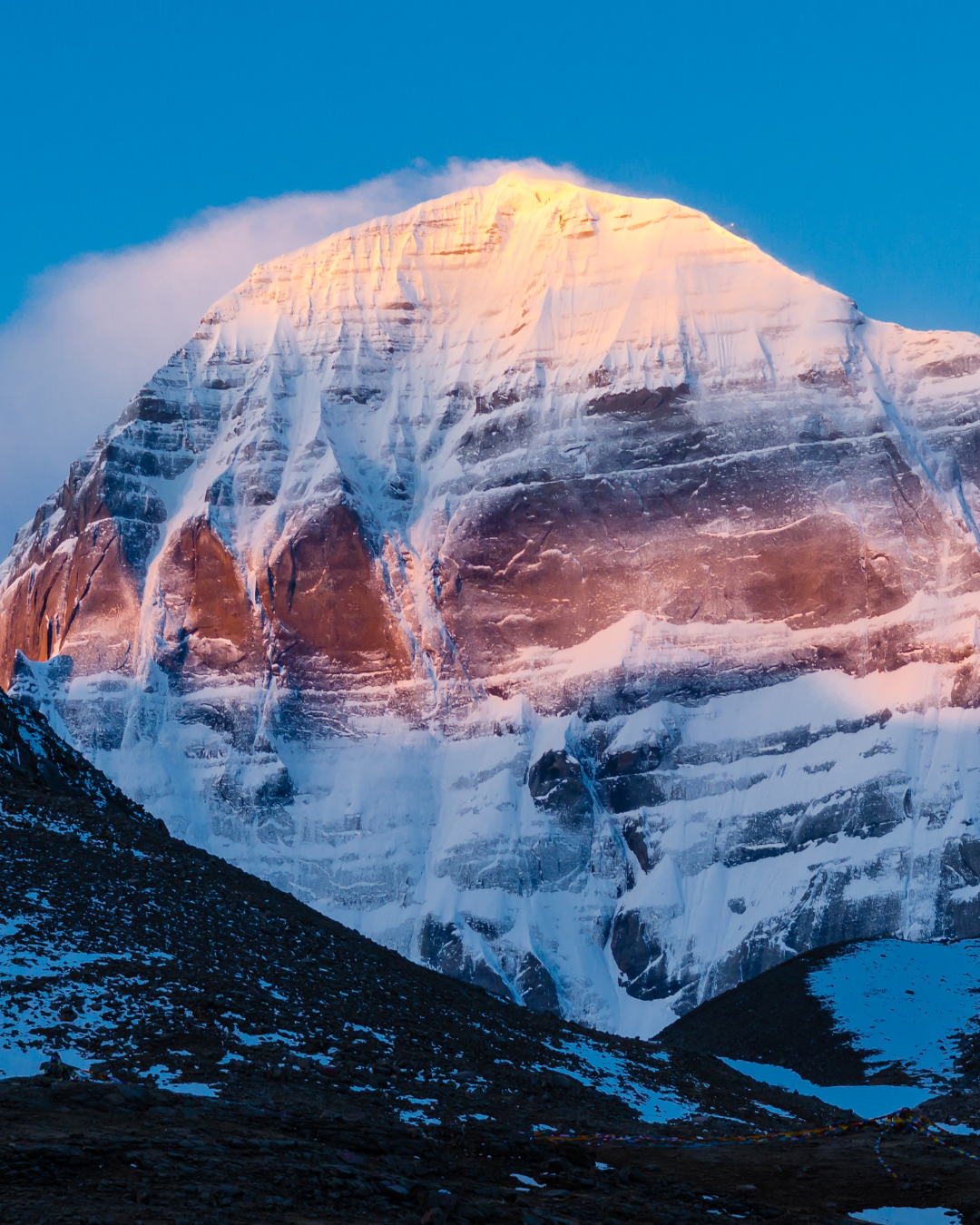
Some journeys are measured in kilometres. Others are measured in what they ask of us. The journey to Kailash Mansarovar belongs to the second kind. For centuries, pilgrims have travelled towards Mount Kailash, crossing some of the world's most dramatic landscapes to reach a mountain regarded in Hindu tradition as the sacred abode of Lord Shiva. Beyond its physical beauty, Kailash holds a significance that is difficult to describe through geography alone. It is a place of devotion, endurance, silence and surrender. You may begin the journey thinking about the mountain. But somewhere along the way, the mountain begins to change the way you think about the journey itself.
Why Is Kailash Mansarovar Sacred?
Mount Kailash rises in the Tibetan Himalayas and is revered by several religious traditions. For Hindus, it is traditionally regarded as the abode of Lord Shiva and Goddess Parvati. The region also holds profound significance in Jain, Buddhist and Bon traditions. Uttarakhand Tourism describes Kailash as one of the most sacred mountains in the Hindu tradition and notes its importance across these traditions. For a Shaivite pilgrim, however, Kailash is not simply another temple to visit. It is Shiva's mountain. That distinction matters. There is no grand temple standing at its summit waiting for a visitor. The mountain itself is sacred. Its presence becomes the place of worship. This is perhaps one of the most powerful ideas at the heart of the Kailash Mansarovar pilgrimage — sometimes the sacred is not something built by human hands. Sometimes, it is the landscape itself. The mountain. The sky. The wind. The silence. And the person standing within it.
The Mountain That Pilgrims Travel Towards
From a distance, Mount Kailash can appear almost impossibly still. The surrounding landscape is vast and austere. There are stretches where the horizon seems to contain more sky than land. The air becomes thinner as the altitude rises, and the physical demands of the journey become impossible to ignore. This is not a pilgrimage where everything is comfortable. And perhaps that is part of its meaning. A pilgrimage asks something from the person undertaking it. The journey to Kailash asks for patience. Physical preparation. Mental resilience. Acceptance of uncertainty. It asks you to slow down because the landscape leaves you no choice. There is no rushing through a high altitude pilgrimage. Every step has to be considered. Every breath becomes noticeable. And eventually, the things that seemed important before beginning the journey can start to feel very far away.
Lake Mansarovar, A Sacred Water
Near Mount Kailash lies Lake Mansarovar, another profoundly sacred landscape. For Hindu pilgrims, the lake has traditionally been associated with purity and spiritual renewal. The Ministry of External Affairs has described the lake as holding deep religious significance within the Kailash Mansarovar Yatra, alongside the physical challenge and beauty of the journey. Water has always occupied an important place in Indian spiritual traditions. We go to rivers to pray. We bathe before rituals. We offer water to deities. We carry water home. We remember people beside water. Perhaps this is why Mansarovar feels so significant within the larger Kailash pilgrimage. The mountain represents stillness. The lake reflects it. A pilgrim standing beside Mansarovar may see an immense landscape stretching outward, but there is also something deeply inward about the experience.
The water invites reflection. What have I carried here? What am I ready to leave behind? What am I asking for? And what am I willing to accept? These questions do not necessarily need immediate answers. Like the mountain, they can simply remain.
The Pilgrims Who Make This Journey
Every person who travels to Kailash arrives with a different reason. One pilgrim may have dreamed of seeing the mountain since childhood. Another may be fulfilling a promise made years ago. Someone may be travelling in memory of a parent. Someone else may be searching for peace after a difficult period in life. And another may simply feel drawn towards a place they have heard about all their lives. From the outside, they may all look like travellers following the same route. But they are not carrying the same journey. This is one of the most beautiful things about pilgrimage. We can share a road without sharing a reason. We can walk beside someone for days without knowing the story that brought them there. At Kailash, those stories become part of the landscape.
The Meaning of the Kailash Parikrama
One of the central experiences of the pilgrimage is the parikrama, or circumambulation, of Mount Kailash. For pilgrims, walking around the sacred mountain is not simply a trek. It is an act of devotion. The route is physically demanding, with high altitude and challenging terrain making the experience considerably more difficult than an ordinary mountain walk. Uttarakhand Tourism notes that the traditional circuit around Mount Kailash involves approximately 53 kilometres. Every step therefore carries a different weight.
There may be moments when the mountain feels impossibly distant. There may be moments when fatigue becomes overwhelming. And then there may be moments of extraordinary stillness. A prayer. A breath. A glance towards the peak. A fellow pilgrim offering encouragement. These small moments can become more meaningful than any grand event. Because pilgrimage is rarely about arriving alone. It is about everything that happens while you are making your way there.
When the Journey Becomes a Practice in Surrender
Modern travel often gives us control. We choose our flights. Our hotels. Our routes. Our restaurants. Our schedules. We expect the journey to respond to us. Kailash asks us to do the opposite. Weather can change. The body can become tired. Plans may shift. The landscape cannot be negotiated with. You cannot ask a mountain to become easier. You can only learn how to move through it. That can become a spiritual lesson in itself. There is a particular kind of humility that comes from being reminded that we are not always in control. Perhaps this is one reason the Kailash Mansarovar pilgrimage remains so powerful for those who undertake it. The journey creates space for surrender. Not surrender as defeat. Surrender as acceptance.
More Than a Destination
It is tempting to describe Kailash through superlatives. The sacred mountain. The ultimate pilgrimage. The extraordinary landscape. The difficult trek. But descriptions like these can sometimes make the place feel distant. A pilgrimage is not only about the destination. It is about the relationship between the destination and the person travelling towards it. For one pilgrim, Kailash may represent Shiva. For another, it may represent silence. For someone else, endurance. For another, the memory of family. And for someone else, simply the experience of standing before something larger than themselves. There is no single correct emotional response. And perhaps that is important to remember. Faith is deeply personal.
Travelling With Respect
A sacred landscape should never be treated simply as a backdrop for photographs. Kailash is a living pilgrimage landscape, not merely a dramatic Himalayan destination. That means travelling with awareness. Listen before speaking. Observe before photographing. Respect local traditions and fellow pilgrims. Understand that rituals may have meanings that are not immediately visible to an outsider.
And remember that the people who live in and around sacred landscapes are not part of the scenery. They are part of the living story of the place. The same principle applies to the environment. High altitude landscapes are fragile. What a traveller carries into such a place should, wherever possible, be carried back out. The goal is not simply to experience a sacred landscape. It is to leave as little disturbance behind as possible.
Preparing for a Kailash Mansarovar Pilgrimage
The Kailash Mansarovar Yatra is physically demanding and should never be approached like an ordinary holiday. For Indian pilgrims travelling through the official Government of India programme, the Ministry of External Affairs requires medical screening and other formalities. The official process has included medical examinations in Delhi and additional fitness assessments during the journey. The 2026 Government of India Kailash Manasarovar Yatra was scheduled for June to August, with ten batches of 50 yatris each, according to the Ministry of External Affairs.
Because routes, eligibility requirements, schedules and arrangements can change, travellers should always consult the latest official guidance before planning the pilgrimage. This is especially important because Kailash is a high altitude journey where physical preparation is not optional. The mountain does not care how experienced a traveller is. It asks everyone to respect it.
The Deeper Meaning of the Journey
Perhaps the most meaningful part of Kailash is not the moment when you finally see the mountain. Perhaps it is everything that happens before that moment. The early morning. The long road. The changing landscape. The tired feet. The silence between conversations. The stranger who walks beside you. The prayer you repeat when you are exhausted. The thought of someone you left behind. The feeling that, despite everything, you have continued. These are the things that transform a difficult journey into a pilgrimage.
Because a pilgrimage is not simply movement towards a sacred place. It is movement within ourselves.
Returning From Kailash
Eventually, every pilgrimage asks us to turn around. The mountain remains. The lake remains. The landscape continues as it did before we arrived. But the pilgrim leaves carrying something different. Perhaps it is a photograph. Perhaps it is a memory. Perhaps it is a deeper connection to Shiva. Perhaps it is simply the knowledge that they stood before something that made their own life feel both very small and profoundly meaningful. You may leave Kailash with fewer answers than you expected. That is not necessarily a failure.
Some places are not meant to answer every question. Some places simply teach us how to sit with the questions. Kailash may be one of them. For the Shaivite pilgrim, the journey towards Mount Kailash is a journey towards Shiva. But beyond faith, it can also become a journey towards stillness, humility and perspective. You arrive looking at a mountain. You leave carrying a memory of what it felt like to stand before something greater than yourself. And perhaps that is where the journey truly becomes a pilgrimage.